how to asses a hype
The genAI hype is crashing against reality. The profits that the use of genAI have been promised have not materialized. No near-total white-collar jobs wipe-out happened, as some doomsday fortune-teller predicted. Companies re-hire call center agents they fired a while ago. Seems that genAI chatbots wasn’t such a good bet. Codebases are more bug-ridden than ever. Using genAI trained on bananaware (the product matures at the customer’s site) wasn’t such a terrible good idea, neither. I’m still waiting for those butt-ugly genAI images disappearing from blog posts and websites, like some of the 90’ties worst style crimes on the web did.
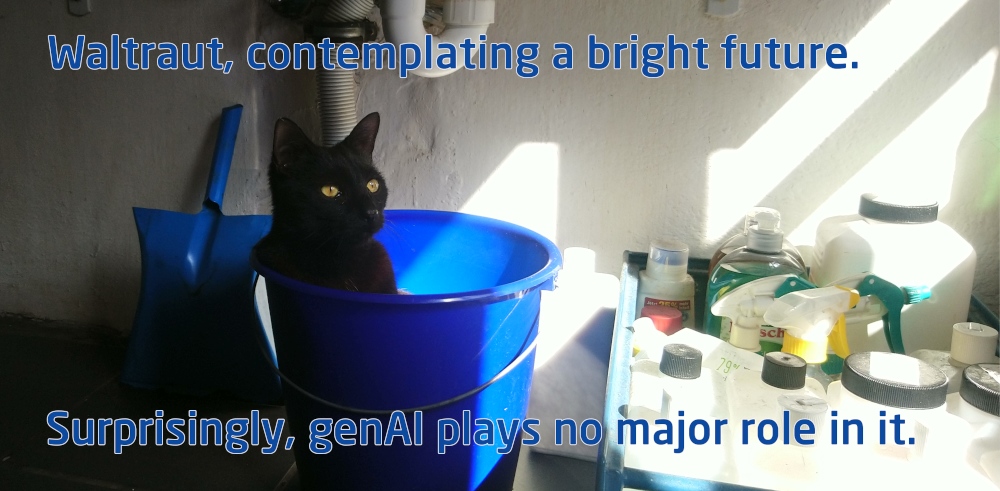
That’s not surprising at all. Hypes come, hypes fade (or crash). The IT industry is an especially fertile ground for bullshit hypes. Whenever I see ’the next big thing’ taking off, I ask myself the following questions:
- is it plausible? – if it sounds too good to be true, then most likely it isn’t true.
- does it look like a fraud? – if it looks like a fraud, it probably is. Like NFTs, where JPEGs were sold like they were original Vincent van Gogh paintings. Or like the cryptocurrency Ponzi scheme behind Blockchain.
- is a recurring scheme repeated, again? – like the recurring scheme of the disappearing developer. ADF, low-code, no-code, near- and offshoring, all of that didn’t make devs disappear anywhere.
- who are the main actors? – is it an exclusive circle like a niche area in research? Are folks involved that have a record of employing shady practices? If someone like Eric Schmidt (former CEO and Chairman of Google) fuels the genAI hype, you know something is off. Is there a broader spectrum driving the hype?
- are the main actors in touch with reality? – Metaverse: we’d all work in a virtual 3D world with unimaginable business opportunities. If I’d be loaded with cash such that I could buy islands or the whole economy of some states, may be then I’d think too, that this is a good, sound idea. But I live in a non-virtual world and make a living there — I need a somewhat decent roof over my head, food in the fridge, and real, non-virtual social connections. I prefer innovations created by people who share this space with me.
- what is the framing? what language is used? – FOMO and FUD are red flags here. If someone tells me “this will be disruptive”, that’s a marketing gag. Disruptions come unannounced.
- is it worth the effort? is it sustainable? – How much do I have to put in to participate? Is it fun to participate? What do I get back?
- cui bono – who benefits? – does the new technology or methodology improve my very personal situation, and the situation of other people? – I mean all people, not only the billionaires. Does someone try to get his/her hands into my pocket? Does someone try to sell me shovels for the next gold rush? Does someone try to hijack my attention? Power grows where attention goes.
- what are the side effects? – IoT brought us some funky toys, but I don’t want my fridge talking to its manufacturer. Don’t let me get started on Alexa. genAI comes with an unbearable exploitation of click workers and is an ecological desaster. And that’s just for starters.
Last not least: is this even a hype, or is it a boom, or a fraud – I find the lines between hype and fraud can be blurry at times.
Most of these considerations are trivial. It’s often the trivial stuff that people trip over, including myself. I know that something is a hype or fraud if for a few or more of those points red flags come up.